20 December 2010

20 December - O Clavis David; St. Thomas Eve; Moon Eclipse; Bachelor Tax

Astronomy: Tonight (actually tomorrow morning) is a total eclipse of the Moon, which will be fully visible from North America (also South America, the islands of the Pacific, Greenland, northwestern Europe and northwestern Africa).  Tomorrow evening, it will be visible in Northeast Asia, the Philippines, eastern Indonesia, eastern Australia and New Zealand.

For watchers on the East Coast, the Moon enters penumbra at 1:33 am EST and exits at 5:01 am EST.  The totality phase starts at 2:41 am EST and ends at 3:53 am EST.  Yep, for a little over an hour, the moon disappears.

According to EarthSky, this is the northernmost total lunar eclipse for several centuries, and won't be seen again this far north on the sky's dome until this day in 2485.

See their page here for start and end times in the U. S. and in Universal Time.
------------------------------------------------------------------
The antiphon today is O Clavis David (O Key of David), our plea to be liberated from the prison of our sins.

O Clavis David, et sceptrum domus Israel; qui aperis, et nemo claudit; claudis, et nemo aperit: veni, et educ vinctum de domo carceris, sedentem in tenebris, et umbra mortis.  

O Key of David, and Sceptre of the house of Israel, 
that openeth and no man shutteth, and shutteth and no man openeth, 
come to liberate the prisoner from the prison, 
and them that sit in darkness, and in the shadow of death. 

-------------------------------------------------------------------
Tomorrow being the feast of Saint Thomas, today is celebrated as Saint Thomas Eve.

And for tonight, there are two love charms:

To see a vision of your loved one, peel a large red onion, and stick nine pins into it.  Then say:

"Good Saint Thomas, do me right
Send me my true love this night,
In his clothes and his array,
Which he weareth every day."

Then place the onion under your pillow.  You should dream of your true love.  [If your mom wants to know who has been getting into her sewing basket, or what happened to the onion that was slated for tonight's hamburgers, tell her they were used in a Good Cause]  Good luck.

An older charm says to "take an onion, pare it, and lay it in a clean handkerchief under your pillow [make it a sweet onion, if you want to sleep].  Put on a clean smock [or in our day, a nightgown], and as you lie down, lay your arms abroad, and say these words:

"Good Saint Thomas, do me right
And bring to me my love this night,
That I may view him in the face,
And in my arms may him embrace."

Then lying on thy back with thy arms abroad, go to sleep as soon as possible, and in your first sleep, you shall dream of him who is to be your husband, and he will come and offer to kiss you."  [And that better be all he offers, at least until you get to the altar!  Of course, if he finds out that you sleep with onions under your pillow, you might not get that far.]
----------------------------------------------------------------------------------
Even more helpful to the cause of getting a husband was Missouri's Bachelor Tax, which was enacted on this day in 1820, and levied $1 per year on all unmarried white males between the ages of twenty-one and fifty. 

"Men far outnumbered women in early Missouri, and the legislators apparently enacted this legislation in the belief that it would encourage marriage, the family, and social stability and also would ensure that the footloose single male populace would contribute its share to the general welfare."
William E. Foley, The Genesis of Missouri: from Wilderness Outpost to Statehood, p. 287.

Not paying the tax could result in jail-time; I can just picture the carefree bachelor trying to decide which ball-and-chain would be preferable.

19 December 2010

19 December - O Radix Jesse; Valley Forge and Pepper Pot Soup

The antiphon today is "O Radix Jesse" (O Root of Jesse), where we pray, with more than a little impatience, for our ruler and guide to come to us. 

O Radix Jesse, qui stas in signum populorum, super quem continebunt reges os suum, quem Gentes deprecabuntur: veni ad liberandum nos, jam noli tardare.

O Root of Jesse, which standest for an ensign of the people, 
at Whom the kings shall shut their mouths, Whom the Gentiles shall seek, 
come to deliver us, do not tarry.
--------------------------------------------------------------------------------
In 1777, General George Washington led his weary troops of the Continental Army to their winter quarters in the easily defended area of Valley Forge in eastern Pennsylvania, close enough to Philadelphia to harry the British troops who had captured the city, far enough to prevent any surprise attacks, and between Philadelphia and York, where the Continental Congress had fled.  The Army would remain there until June 1778.  In between, they drilled under Baron von Steuben into a honed fighting force, and welcomed the alliance with the French, which added more troops and ships to their number.
 
From the Valley Forge National Historic Park site:
Few places evoke the spirit of patriotism and independence, represent individual and collective sacrifice, or demonstrate the resolve, tenacity and determination of the people of the United States to be free as does Valley Forge. The historic landscapes, structures, objects, and archeological and natural resources at Valley Forge are tangible links to one of the most defining events in our nation's history. Here the Continental Army under Washington's leadership emerged as a cohesive and disciplined fighting force. The Valley Forge experience is fundamental to both American history and American myth, and remains a source of inspiration for Americans and the world.
 
Scroll down the Valley Forge NHP page to read about the men (and women) of the Continental Army, and how they fared that winter.  The traditional vision of ragged, starving, dying men will recede a little, and give you a better understanding about the significance of this 3rd of eight winter encampments. 
One of my ancestors, John Collier, rejoined his company in the 7th Virginia Regiment at Valley Forge in February of 1778.  This is what was written about him in one of the family histories: "Whenever John Collier noticed that his children or grandchildren showed the least indication of wastefulness, he at once would reprimand them, telling them of the suffering at Valley Forge, how he had seen soldiers fight for a kernel of corn; how he and others lacked shoes and socks to keep their feet warm, and as they walked in the snow, would leave the marks of blood from their tender, frost-bitten feet; how some of the soldiers had so little clothing that, when they stepped out of their huts, they had to throw their bedding around them..."

[Sounds a lot like the traditional admonishment: "When I was your age, I walked 5 miles to school, in 10 feet of snow, uphill both ways... and I was grateful!" Nothing has changed.]

Legend has it that PHILADELPHIA PEPPER POT SOUP was first made there in Valley Forge to lift the flagging spirits of the dispirited soldiers. As the story is told and retold, each time with a little change here and addition there, morale was low and desertions frequent.  General Washington ordered the mess cook to make something that would cheer his troops.  There being nothing to hand but some tripe, peppercorns, and meat scraps, the cook used them to produce a hot, filling soup, naming it after his hometown.  The next 'history' of the soup that you read will explain very carefully that Pepper Pot is part of African cuisine, which arrived here via the West Indies (with strong hints that no white person from the northern colonies could possibly create a separate version), and the next story after that will state unequivocally that the mess cook was West Indian.  That's how legends are born.

Be that as it may, here is one recipe for the legendary soup:

For 6 servings.
First, make the Butter Balls: Mix 1 cup of flour, 1-1/2 teaspoons of baking powder, and 1/2 cup of melted butter.  Shape into dime-sized balls.  Chill several hours.

Finely cut up 1/2 pound of fresh tripe.  Set aside. 

Simmer 1 veal shin in 2 quarts of water and 1 tablespoon of salt for 2 hours.  Strain.  Return broth to kettle, and add the tripe and 1 pound of boneless veal.  Simmer for another 2 hours, or until meats are tender.  Remove veal, cut into bite-size pieces, and return to kettle.

Cook 2 cups of flour in a skillet until golden brown.  Blend in 2 cups of water, and stir into veal broth. Stir in 2 cans of consomme and 2 cans of tomato soup.  Simmer for 1 hour.

Season with salt, ground red pepper, and ground allspice.  Add 2 - 3 hard-cooked eggs, cut into chunks, and the Butter Balls.  Simmer for 1/2 hour and serve.

Oh, and Pepper Pot Day is celebrated on 29 December, ten days hence, when it was supposedly invented.  Maybe morale was low and desertions frequent long before the troops got to Valley Forge - otherwise, it is hard to see how morale (and food stores) could drop so far in 10 days, all of which were spent in setting up camp, building huts, and digging redoubts.  But that's legend for you.

18 December 2010

18 December - Ember Day; O Adonai; Saki (H. H. Munro)

Today is the third Ember Day of this quarter.  The weather today traditionally foretells the weather for March.  Bright, clear skies, and chilly air in the smallest state.
-----------------------------------------------------------------------------
Today the Antiphon is "O Adonai", in which we ask the Lord of All to come quickly and save us with his justice [his justice, not the world's]:

O Adonai, et Dux domus Israel, qui Moysi in igne flammæ rubi apparuisti, et ei in Sina legem dedisti: veni ad redimendum nos in brachio extento.

O Adonai, and Ruler of the house of Israel, 
Who didst appear unto Moses in the burning bush, and gavest him the law in Sinai, 
come to redeem us with an outstretched arm!  
--------------------------------------------------------------- 
This is the birthday of my favorite author, Hector Hugh Munro, who wrote delightfully wicked stories under the pen name 'Saki'.

He was born in Burma in 1870, but at the early death of his mother, and his father being posted to India, he and his brother and sister were left in England to be brought up under the care of his paternal grandmother and aunts, whose characters can be seen in Sredni Vashtar, The Lumber Room, and The Sex That Doesn't Shop.  Like Conradin, he was always rather sickly.

You can read his sister's biography of him here and Wikipedia's article here.  Sadly, he was killed by a sniper's bullet in the trenches of World War I on 13 November 1916.  Oh, to think of all the stories that were never written.

Meanwhile, dull winter afternoons are a good time to curl up with the likes of Reginald and Clovis Sangrail, and meet the not-quite truthful Mrs Packletide (Mrs. Packletide's Tiger) and the all-too-truthful Woman Who Told the Truth.  Enjoy the 'peaceful' English countryside in The Peace of Mowsle Barton and The Blood-feud of Toadwater, with further side trips into the uncanny with Tobermory and Gabriel-Ernest.  In honor of the season, get tips on Christmas presents from "Down Pens" and Reginald on Christmas Presents, and enjoy Christmas revelry with Bertie's Christmas Eve and A Touch of Realism.

I've often wished to be Lady Carlotta teaching The Schartz-Metterklume Method, or Mrs. Pentherby (Excepting Mrs. Pentherby) who said horrible things in a matter-of-fact innocent way, and matter-of-fact innocent things in a horrible way, or had the story-telling ability of the niece in The Open Window or the bachelor in The Story-Teller.  You can read all of these and more, including stories that were never collected in books, here.  If you have never read Saki, now is a good time to start.


17 December 2010

17 December - Ember Day; O Sapientia

This is the second Ember Day of this quarter.  The weather today traditionally foretells the weather of February.
Another clear, sunny, and cold day.
------------------------------------------------------------------
Today begins the Golden Nights - seven days preceding Christmas Eve, when we intensify our prayers for our Lord's coming by reciting the 'O Antiphons' before and after the Magnificat.

Tonight we begin with O Sapientia - O Wisdom.  I use the translation provided by Fisheaters.

O Sapientia, quæ ex ore Altissimi prodiisti, attingens a fine usque ad finem, fortiter suaviterque disponens omnia: veni ad docendum nos viam prudentiæ. 

O Wisdom that comest out of the mouth of the Most High, 
that reachest from one end to another, and orderest all things mightily and sweetly, 
come to teach us the way of prudence!


16 December 2010

16 December - Catherine of Aragon; Orange and Pomegranate Compote

Today in 1485, Queen Isabella of Castile, in the midst of her continuing campaign to regain southern Spain from the Moors, gave birth to a daughter in the Archbishop's Palace of Alcala de Henares (near Madrid).  The baby was christened Catalina after her great-grandmother, Catherine of Lancaster, and from her father, King Ferdinand of Aragon, she was styled "of Aragon".

Juan de Flandes, c. 1495
Catalina's early years were full of the completion of the Reconquista by her parents, which ended in 1492 with the surrender of Granada; this was followed immediately by the discovery and exploration of the New World by Columbus, and the beginnings of the Renaissance in Spain.  Her mother was a firm believer in a humanist education for her daughters, and Catalina, like her sisters, was tutored in studies more usual for a medieval prince.

Besides lessons in deportment (including dancing and music), religion, and needlework skills, she learned to speak French, Latin, and Greek, and studied classic literature and philosophy, genealogy, and canon and civil law.  From her mother, she learned that queens could lead armies and reconcile warring factions; from both parents, she learned that a politically expedient marriage could also be a successful partnership.

As a measure of protection against France, Catalina was betrothed in 1489 by the Treaty of Medina del Campo to Prince Arthur of England (born in September 1486), son of Henry VII and Elizabeth of York.  In the tangled genealogy of royal Europe, Catherine had nearly as good a claim to the throne of England as her future husband, as she was legitimately descended from John, Duke of Lancaster, the third son of Edward III, while Arthur's best claim came through his mother and the House of York, who descended from the second and fourth sons of Edward III (of Henry VII's spurious claim to the throne via a bastard child of John of Lancaster, the least said, the better).  The newly established Tudor monarchy was bolstered by this arrangement with the powerful rulers of Spain, achieving a measure of legitimacy in the eyes of Europe.  Catalina and Arthur were married by proxy in May of 1499; in September 1501, she sailed from Spain, arriving in England in October.

Not yet 16, she married the fifteen-year-old Prince of Wales that November; he died the following April.  For the next seven years, Catherine, the Dowager Princess of Wales, lived as a pawn between the machinations of her father and father-in-law - ostensibly betrothed to her brother-in-law Henry, but certainly never treated as such.  This came to an end with the death of Henry VII in 1509.

And then she married Henry VIII...

You should know the rest of the story, but if not, there are more than enough books at the library and websites online to fill that lack.

Catalina's badge was the pomegranate, seen here above her head in this woodcut of her coronation.  In honor of this Infanta of Spain, have ORANGE AND POMEGRANATE COMPOTE for dessert.

This is very simple.  Remove the rind and white skin from 4 oranges; slice them on a plate (to catch the juice) and place the thin slices in a glass serving dish, or arrange them in 4 individual serving dishes.  Remove seeds from 2 pomegranates (see below for how to do that), and sprinkle them over the orange slices.  Sprinkle the fruit with about a tablespoon of the reserved juice from the sliced oranges, and the same amount of fresh lemon juice and rose water.  Sprinkle with sugar to taste, and chill until ready to serve.

This being the time of year when Clementines show up at the Commissary, I usually have a crate or two on hand, and use them rather than oranges.  Also, I am not very handy when it comes to sprinkling lemon juice, especially among separate dishes (one dish always gets more than its share); a spritzer is my friend here.  And while I am much better at sprinkling sugar on anything (about 5 decades of experience), I also place the sugar bowl within reach of those who don't think I have been lavish enough in my application.

How to remove the seeds without making a mess?  Go Here, and learn.  Of course, if your inner three-year-old likes to be one with your food, the fruit has excellent staining power, and will turn lips, face, fingers, hands, and clothes a beautiful red that is not easy to eradicate.  Trust me.

15 December 2010

15 December - Ember Day

Today is the first Ember Day for this quarter, a day of fasting and prayer.  Traditionally, the weather today foretells the weather of January.  Clear, bright, sunny... and very chilly.  Very chilly indeed.

The medieval Golden Legend says that winter is cold and moist [with which we have no argument here].  In winter (says the writer), we fast to chastise the coldness of untruth and of malice, to be mortified to the world as the dying plants, to lessen the phlegm of lightness, forgetting, and inconstancy, and to become ancient and old by prudence and an honest life.

Modern prayers tend to be for our clergy, for our right use of the world's resources, for women facing childbirth, and for justice.  All of these are good intentions, and should keep your prayer-life busy for these three days.

14 December 2010

14 December - Halcyon Days; Floating Island Pudding; Chocolate Meringues

Traditionally, the Halcyon Days begin today and continue through the 28th of December - which means smooth sailing, at least in the Mediterranean.

Alcyone was a Greek maiden, daughter of King Aeolus of Thessaly, married to Ceyx, the half-divine son of Eosphoros (the Morning Star).  They were so happy in their marriage, that she called him Zeus and he called her Hera, which angered the original owners of those names, the king and queen of the gods.  One story says that Zeus launched a thunderbolt at the ship which carried Ceyx and sank it; in her grief, Alcyone threw herself into the sea, and both were changed into aquatic birds: the kingfisher (halcyon) and the gannet (ceyx).  Another omits the shipwreck and merely says that the two were turned into birds for their impiety.

It was said that during the nesting period of the kingfisher, the seas remain calm.  This is supposed to take place a week before and a week after the Winter Solstice, as the kingfisher builds her nest and lays her eggs.  This in its turn gave rise to the artistic vision of the bird serenely riding the calm waters on her QE2 nursery.

I suppose that Bird's Nest Soup is the most apropos item on the menu, but as I don't like it, you are on your own for it.  Maybe a FLOATING ISLAND PUDDING, instead:

First make your custard.  Divide 6 cold eggs.  As 4 egg whites will be used for the meringues, separate 4 eggs, yolks in one bowl, whites in another.  Then divide the remaining 2 eggs, yolks with their fellows, whites in a third bowl.  You will have a bowl with 6 yolks, a bowl with 4 whites, and a bowl with 2 whites.  Set the whites aside, but do not chill.

Heat 2 cups of milk in the top part of a double boiler.  Heat water in the lower part of the double boiler to boiling.  Mix the 6 yolks with 3 tablespoons of sugar and a dash of salt (mix thoroughly, but don't beat).  When bubbles appear around the edge of the milk, pour a little of it (about 1/2 cup) into the egg mixture and blend well.  Pour this into the milk.  Place the top part of the double boiler over the boiling water in the lower part.  Cook, stirring continuously, until thick enough to coat a metal spoon.  Remove from heat; mix in 1 teaspoon of vanilla.  Pour into a shallow serving dish and chill.

Now for the meringue islands.  Fill a skillet with about 1 to 1-1/2 inches of water and bring to a simmer.  Beat the 4 egg whites (which should be at room temperature now) in a deep bowl with an electric mixer until fluffy, then gradually beat in a pinch of salt and six tablespoons of sugar.  Continue beating until meringue stands up in stiff peaks.  Carefully drop tablespoonfuls of the meringue in the simmering water, one at a time.  When they are set (about 2 -3 minutes), carefully lift them out of the water with a slotted spoon, and place on top of the chilled custard, so that they resemble islands in a custard sea.  Chill before serving.

You can use the other 2 egg whites in CHOCOLATE MERINGUES, by beating the whites with 1/8 teaspoon of salt until stiff.  Add 1/2 cup of sugar, one tablespoon at a time, beating for 2 minutes after each addition; mixture should be very stiff.  Stir in 1 teaspoon of vanilla and fold in 1 cup of chocolate pieces (I like really dark, bitter, chocolate; choose your own preference).

Preheat oven to 300 degrees F (make sure the oven is fully preheated before baking).  Line cookie sheets with brown paper (I cut up paper bags; you can also use ungreased cookie sheets), and drop meringue mixture onto them by teaspoonfuls.  It is optional, but I like to top mine with a bit of cut-up maraschino cherry; red and green are suitable for this time of year.  Bake for about 25 minutes.  Remove and cool.  This will make 2 to 3 dozen, depending on the size of your teaspoonfuls, but they melt in the mouth like true meringues and can be addicting.

I hope the seas of your life are calm right now.

13 December 2010

13 December - Saint Lucy


Today is the feast of Saint Lucy (or Lucia), Virgin and Martyr, who suffered, circa 303, in the persecutions of Diocletian.  A young lady of Syracuse (Sicily) who preferred a religious single life to marriage, she gave away her patrimony in alms, and was denounced as a Christian to the authorities by her rejected fiance.  The governor first tried to talk her out of her beliefs; when that failed, he (thinking that her power lay in her physical chastity) ordered her to be taken to a nearby brothel and gang-raped until she died.  They tried to drag her away to the brothel, but she could not be moved - not by one man, or a thousand, or a team of oxen.  The governor then ordered her burned alive, but the fire did not hurt her.  Finally, she was dispatched with a sword to the throat.

She is the patron of Syracuse, and of those suffering from blindness, eye-problems, and throat infections.

Her name meaning "light", she is celebrated by bonfires and torchlight processions, especially in Italy.  In the northern countries, which followed the Julian calendar until the 18th century, Saint Lucia's Day was the longest night of the year, and the saint of light was much welcomed.  Swedish Saint Lucia festivities are probably the most well-known, with the eldest daughter of the house, dressed in white with a red sash and a wreath with candles on her head, serving her parents coffee and St. Lucia buns (recipe here).

John Donne, in England, wrote:
TIS the yeares midnight, and it is the dayes,
Lucies, who scarce seaven houres herself unmaskes,
  The Sunne is spent, and now his flasks
  Send forth light squibs, no constant rayes;
    The worlds whole sap is sunke:...

Her usual attribute is a dish holding her eyeballs.  Two stories account for this: 1. That an importunate suitor claimed that he could not forget her, for the memory of her beautiful eyes stayed with him.  She then plucked out her eyes and sent them to him, begging to be left alone. [Rather snarky]  2.  That her eyes were plucked out during her torture.

For this, EYEBALL CANDIES, which you probably haven't seen since Hallowe'en, are the perfect dessert.  If you have made Buckeyes, the recipe will look familiar.

Cream together 1/2 cup of softened butter and 1-1/2 cups of creamy peanut butter.  Stir in 1 teaspoon of vanilla and 2 cups of powdered sugar, and mix well.  Chill this mixture for half an hour (makes it easier to form.  Trust me).  Spoon out a little dough and roll it into a small ball (small is relative; 1-1/2 inch diameter works for me).  Continue to make balls out of the rest of the dough; place them on wax paper and chill again for 1/2 hour.

While the dough-balls are chilling, get out 12 ounces of white chocolate (for dipping) and follow the instructions given for melting it.  Mine calls for microwaving it, which is probably the easiest.  Dip the eyeballs into the chocolate, using slotted spoons, skewers, or toothpicks.  Put the dipped eyeballs on a sheet of wax paper and cool until firm.

For the irises, you can either color the remaining chocolate with blue food coloring (or divide it, and color one part blue and one part green), or you can use decorating gels in those colors (as I did), or use Lifesaver candies.  Make a small circle on the top of the eyeball and press a miniature chocolate-chip in the center (that's the pupil).  I turn my chocolate chip upside down, so the pupil is flat.  You can use the regular-size chocolate-chips; the eyes will look like they've been smoking something.

If you don't want to go through the job of mixing peanut butter and chilling it, one recipe uses Vanilla Wafers as the eyeballs.  Dip into white chocolate and decorate as usual.  The eyeball may be flat, but still quite good.

"Sacrifice which pleaseth God is to visit the widows and orphans, and to help them in their need: I have not ceased these three years past to make to God such sacrifice, and forasmuch as I have no more of which I may make yet such sacrifice, I offer to him myself, let him do with his offering as it pleaseth him." from The Golden Legend, "The Life of the Blessed Virgin Lucy"

12 December 2010

12 December - Geminids; Pennsylvania

Astronomy: Meteors from the Gemind Meteor Shower have already been spotted, but according to EarthSky, the best time for watching will be late tomorrow evening through dawn on the 14th, with optimum viewing after the moon sets at midnight [in the smallest state, moon-set will be at 12:18 Tuesday morning.  See The Old Farmer's Almanac for moon-set times in your area].  And check out EarthSky's ten tips for watching the Geminids.
--------------------------------------------------------------------------
Today is the Third Sunday in Advent - Gaudete Sunday, when we set aside our penitential preparation and rejoice that Our Lord is coming to us.  Light the rose-colored candle tonight.

[And the color is Rose - not Pink.  Pink is not a liturgical color.  Some people get away with using pink candles, because rose is not that easy to find.  So be it.  Just don't call it a pink candle - or pink vestments - or pink anything having to do with liturgy.  For more information, see this article from EWTN's library.]
-----------------------------------------------------------------------

In 1787, the former Province of Pennsylvania ratified the Constitution of the United States, the second state to do so (after Delaware).

If you are studying our nation's beginnings, there are few finer places to do it.  Visit Independence Hall, where delegates from the colonies met first to hammer out a Declaration of Independence and then a Constitution [and if, like me, you loved '1776', try hard not to start singing "Sit Down, John!"].  Then go see Valley Forge National Historic Park, where the Continental Army spent the harsh winter of 1777-1778. 

Move up in time and wander through Gettysburg, where Lee's Confederate Army nearly took the Civil War permanently into the lap of the North.  If you prefer your history spiced with a touch of the unknown, there are Ghost Tours everywhere.

Right now, there is a Christkindl Market in Bethlehem and 'A Dickens of a Christmas' in Manheim.  Or take your chances at one of the many casinos.   Relax on a Wine Tour, or enjoy your favorite winter sport at the ski resorts (some of the western resorts are looking to receive another couple of inches this week).

You can find any number of things to do at Visit PA; currently, they are focusing on winter activities. [And while you are there, have a real Cheesesteak for me.  I've never found one to match it anywhere, and the one I had is a delightful memory.]
---------------------------------------------------------------
From Life in the Breakdown Lane: the Widow had a really bad case of stomach flu and was out of commission for a couple of days.  We now return to our previous schedule.

09 December 2010

9 December - Saint Leocadia of Toledo; Cocido; Mazapan

Saint Leocadia before the Praetor. Mariano Salvador Maella (1739-1819).  Source.

Today is the feast of Saint Leocadia, Virgin and Martyr, a native of Toledo, Spain, who is said to have died around 303 AD in the persecutions under Diocletian.  Denounced to the authorities as a Christian, she was beaten and imprisoned.  One account says that she was tortured and died of the effects while in prison.  Another story is that when she heard of the torture to which 13-year-old Eulalia of Merida was subjected, Leocadia prayed to be taken out of a world of such brutality, and died before she could be tortured.

She is the patron saint of Toledo, and is also venerated in Elche (Spain) with a public holiday.
----------------------------------------------------
A good dinner in honor of Saint Leocadia, especially on a cold night, would be COCIDO (boiled beef).  It takes a while to cook, but it is good and warming.

First, either soak 1/2 pound of dried chickpeas (garbanzos) overnight or use 1 can of chickpeas.

In a soup kettle, combine 1 to 2 pounds of beef (chuck, rump, round, whatever), one quarter of a chicken (1 thigh or leg for each person is usually sufficient; I use 2 thighs and 2 legs), and 2 beef marrow-bones.  Add 1 tablespoon of salt and enough cold water to cover (2 quarts, more or less).  Bring to a boil and skim off any foam; reduce heat, cover and simmer for 1 hour.

Drain your chickpeas; pour boiling water over them (to heat them before they go into the pot), and drain them again.  Wrap them in cheesecloth (loosely, but securely, so they don't fall out) and put the cheesecloth package in the simmering soup.  Taste the soup and adjust the salt.  Skim off foam as it rises.  Cover and simmer again for another hour.

Slice 1 onion, 3 leeks, 2 carrots, and 1 turnip.  Add with 1 sprig of parsley to the kettle.  Cover and simmer for another hour. [I did tell you that it takes a while to make, didn't I?]  Peel and quarter 1 pound of potatoes (2 large or 3 medium).

Strain off the soup.  Either serve it tonight as a first course or save it for future use.  Put everything else back in the kettle and add the potatoes.  Simmer for another 30 minutes, or until potatoes are tender.  There should be enough liquid left in the kettle, even after straining off the soup, to cook the potatoes, but if it looks like the contents are starting to stick to the pan, add a very little water to the bottom.

Remove the cheesecloth package from the kettle and drain.  Heap the chickpeas in the middle of a large platter.  Slice the beef and arrange over the chickpeas.  Surround by cooked vegetables.

A famous dessert of Toledo is its MAZAPAN (marzipan).  One of the differences between it and other European marzipans is in the kind of almonds used; Spanish mazapan does not use bitter almonds.  Another is the amount of almonds used; the ration is 1:1, one part ground almonds, one part sugar.  Also, the sugar and water are boiled first, before the ground almonds (and any flavorings) are added.  You will find a good recipe for Marzipan of Toledo here; meanwhile, here is a simpler recipe:

Separate 2 eggs; reserve yolks for another use.  Lightly beat egg whites.

Finely grind 1 cup of blanched almonds and combine with 1 teaspoon of almond extract and 2 cups of sifted powdered sugar.  Add the egg whites, 1 teaspoon at a time, beating vigorously with a spoon.  Continue adding whites until mixture looks moist. 

Either knead the mixture in the bowl or turn out onto a board, lightly dusted with powdered sugar, and knead until smooth.  Pull off pieces of the dough and form into balls or little shapes (Leocadia is often seen with a tower as a reminder of her prison; bones are another good shape).  You could also roll out the dough to 1/4 inch thick, cut into small circles, and, later, paint on symbols such as a crown (for martyrdom) with food coloring. 

Let the shapes dry before you paint them.   If you brush the shapes with a little egg white and put them under the broiler for a minute, they will have a beautiful brown top. 

Wrap each piece in a bit of wax paper and store in an airtight container.

08 December 2010

8 December - The Immaculate Conception; Two Queens

Today we celebrate the Immaculate Conception of Our Lady, the Blessed Virgin Mary.  As the feast of the patroness of the United States, today is a Holy Day of Obligation for us.

Catholic Culture has a good history of the celebration of this aspect of Our Lady; it is interesting to find that it started with the Eastern church and moved to northern Europe before coming to Rome.  The site has a page which will be useful in teaching the meaning and reason for this feast, and several activities with which to honor it, like a Mary Candle with a silhouette cut-out of Baby Jesus or a plastic baby figure pressed into it, covered by a white cloak until Christmas.  Plant a rose-bush in honor of the "Rose e'er blooming".  Have an All-White Dinner.  Make Spice Cookies to remember the words in Sirach: I gave a sweet smell like cinnamon and aromatical balm; I yielded a sweet odor like the best myrrh; and I perfumed my dwelling as store, and galbanum, and onyx, and aloes, and as the frankincense not cut, and my odor is as the purest balm.

It is a beautiful day in the smallest state for all of the above activities - albeit, a bit chilly for putting in a rosebush.
----------------------------------------------------------
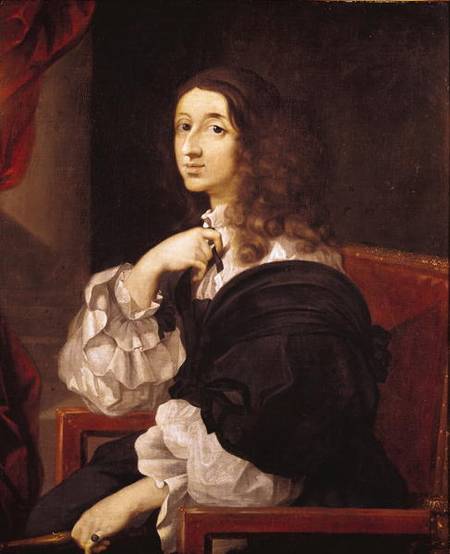
Today is also the birthday of two queens - Mary, Queen of Scots in 1542, and Christina, Queen of Sweden in 1626.

by Clouet, c. 1555
Mary was the daughter of James V of Scotland and his wife, Mary of Guise.  Her father dying six days after her birth, she immediately became Queen and was crowned the following September.  By the time she was 26, she had grown up in France, become the Queen Consort of that country, been widowed, returned to Scotland, put down rebellions, married again, had a son, been widowed again when her husband was assassinated, married again, failed to put down a rebellion, was captured and imprisoned by her own subjects, and forced to abdicate her throne.  She escaped imprisonment, raised an army, lost the battle, and escaped into England.  That's quite a bit of living for a 26-year old.

You can read a detailed biography of her here, and an even more detailed one here from the Marie Stuart Society.

by Bourdon, c. 1652
Christina was the daughter of Gustave II Adolph of Sweden and his wife Maria Eleanora of Brandenburg.  [Note: Sweden did not adopt the Gregorian Calendar until the 18th century; Christina was born on the 8th, not the 18th]  Her father wanted her to be raised as a prince, and she received an extensive education in ancient and modern languages, philosophy, history, and religion, and training in horseback riding, fencing, and the use of firearms.  She became queen at the age of six years, when her father was killed in battle, but put off her coronation until 1650.

And abdicated, by her own choice, four years later.

The rest of her life is also interesting, and you can read various accounts, some more sympathetic than others, here, and here.

07 December 2010

7 December - Delaware and Peach Pie


Today, in 1787, the former colony of Delaware ratified the Constitution of the United States, thereby becoming the First State.  In honor of that, the state has declared (since 1933), that today is Delaware Day  Click on the link for a page devoted to the festival.  This past Saturday and Sunday, First State Heritage Park held a candlelit historical theater event: “Fully, Freely, and Entirely” – Becoming the First State at the Old State House on The Green.  There are other activities under the heading "First Saturdays in the First State".  In fact, it looks as though most of the activities connected with Delaware Day are held on the weekend preceding.  If you missed it this year, mark it on your calendars for next.

And for all the Delawareans who have sought warmer climes,  Maui is holding a Delaware Day celebration on December 8.

Delaware may be small (it tried for years to pass itself off as the smallest state), but it has a beautiful coastline which attracts the summer tourists of the surrounding states.  And there is a lot to do. Visit the Kalmar Nyckel, a re-creation of the ship that brought colonists from Sweden in 1638, who established New Sweden in the area of Wilmington.

Try some paranormal investigation with Delaware Ghost Tours.   Or rent a kayak from Coastal Kayak and take a guided tour of the salt marshes.  Join in the annual powwow of the Nanticoke Indian tribe.  Tour one of the lighthouses: Breakwater East End Lighthouse, Harbor of Refuge Lighthouse, or Fenwick Island Light.  Hike the trail and enjoy the beaches of Cape Henlopen State Park

And when all else palls, visit the wineries of Nassau Valley Vineyards, Fenwick Wine Cellars, and Chaddsford Winery.  Find more events and attractions and things to do at Visit Delaware.

The State Dessert is PEACH PIE, so I know what today's menu will have.

Make or buy your pastry for a two-crust 9-inch pie.  Line pie plate with one crust.
Preheat oven to 425 degrees F.

Slice up enough peaches (about 9) to make 5 cups.  Sprinkle with 1 teaspoon of lemon juice.

In a separate bowl, mix together 1 cup of sugar, 1/4 cup of flour, and 1/4 cup of cinnamon.  Stir this into the peaches.  Pour the whole mixture into the pastry-lined pie plate; dot with 2 tablespoons of butter.

Cover with the top crust; seal and flute edges, and cut slits into the top (to allow steam to escape). [I like to make a lattice top for my fruit pies]  Cover the edges with aluminum foil; remove them 15 minutes before pie is done.  Bake pie for 35 to 40 minutes, or until crust is brown and juice bubbles up through the slits.

If no fresh peaches available (and it is a bit late in the season for them), substitute canned peaches, drained, and reduce sugar to 1/2 cup.

06 December 2010

6 December - Saint Nicholas


Today is the feast of Saint Nicholas of Myra, Bishop.  Children will be checking their shoes to see what the good saint has left them.

The Golden Legend gives the life and miracles of Saint Nicholas, including the well-known story of how he saved three poor young women from lives of degradation, by tossing bags of gold in through their window at night.  This is thought to have given rise to the custom of giving gifts on his day, in imitation of his generosity.

There is also his miracle of aiding mariners in a stormy sea, which led him to be considered the patron of sailors.

The story which made him a patron of children is that where he restored to life the murdered children.
Saint Bonaventure related the story of two young boys who, while traveling to a school in Athens, stopped at an inn.  The wicked innkeeper, tempted by the large amount of money they carried, killed them both, cut up their bodies, and hid the pieces in a salting barrel.  Saint Nicholas discovered this, reprimanded the murderer severely, and called the two boys back to life.

Bonaventure told this story, as no doubt he had heard it, in the 13th century; by the 16th century, the number of children changed to three, and the murderous innkeeper became a butcher, who slew the children for meat he could sell during a famine.  Hence, most representations of the story will show three children in a tub, as does the one above.

A former custom, and one that is still found in some churches, is the election of a Boy-Bishop today.

From All the Year Round: a weekly journal, Volume 61 (1887)

"One of the most curious customs anciently observed in connection with the anniversary of a saint's death was that which on St. Nicholas's Day, December the sixth, was formerly observed at Salisbury Cathedral, or Old Sarum, as it is called.  This consisted of the choice of a boy Bishop from among the choristers, whose term of office lasted from this date until Innocents' Day, twenty-two days later.  The boy was invested with the full authority of a genuine prelate, dressed in Episcopal robes and mitre, and carried also the pastoral crozier.  His fellow choristers, for the time named, acted as prebendaries, and were obliged to render due homage and respect as such.  

The evening before Innocents' Day, there was a special service, attended by the juvenile prelate and his equally juvenile clergy in solemn process, chanting hymns as they marched solemnly up the aisle to the choir.  There the little Bishop took his seat upon the Episcopal throne, surrounded by his youthful clergy, when a service was rendered in remembrance of the massacre, by Herod, of "all the male children that were in Bethlehem".  Multitudes used to assemble to witness the spectacle, and so great was the crush that special enactments were passed to prevent any undue crowding of the little fellows."

This young person and his 'priests' would preach sermons and go about the limits of their 'diocese', collecting money and generally being feted by their neighbors.  Unfortunately, there were abuses; the money collection took on the hue of extortion, and play-acting as prelates seemed to be "rather to the derysyon than to anie true glory of God, or honour of his saints." Forbidden in England by Henry VIII in 1541, but revived for a time by his daughter Mary I, it then slowly died out. 


"I shall only remark, that there might this at least be said in favour of this old custom, that it gave a spirit to the children; and the hopes that they might one time or other attain to the real mitre made them mind their books."  John Strype, Eccleciastical Memorials.

05 December 2010

5 December - St. Nicholas Eve; Speculaas and Pfeffernusse

Weather: If it storms on the first Sunday of the month, it will storm every Sunday.
Fortunately, no storms today.  Just overcast and dreary.
------------------------------------------------------------------ 
Astronomy: New Moon tonight.  When you see the New Moon (which looks like a very thin crescent) turn over the coins in your pocket as a wish for more coins to join them.
------------------------------------------------------------------
This is the Second Sunday in Advent, when we hear the words of Saint John the Baptist, the voice of one crying in the wilderness, "Prepare the way of the Lord.  Make straight in the desert a highway for our God!"
-----------------------------------------------------------------
Tomorrow being Saint Nicholas Day, tonight is Saint Nicholas Eve, which has its own set of traditions, for tonight the Good Bishop pays a visit to each household to discuss the good or bad deeds of the children, all of which are kept in his Golden Book.

From the Every-day Book and Table Book, 1838, an account of Saint Nicholas Eve in Leeuwarden, West Freizeland (now Friesland, a province of the Netherlands):

"At last a loud knock is heard, in an instant the games are suspended, and the door slowly unfolding, reveals to sight the venerated saint himself, arrayed in his pontificals, with pastoral staff and jewelled mitre.

In fine, the family peccadillos being tenderly passed over, and the more favorable reports made the subject of due encomiums, good father Nicholas gave his parting benediction, together with the promise (never known to fail), of more substantial benefits, to be realized on the next auspicious morning.

Before retiring to bed, each member of the family deposits a shoe upon the table in a particular room, which is carefully locked, and is opened the next morning is the presence of the assembled household; when lo! by the mysterious agency (doubtless) of the munificent saint, the board is found covered with bon bons, toys, and trinkets."

The first act of this evening is a visit by the Saint and his henchman, Black Peter (Zwarte Piet; in France, le Pere Fouettard; in Germany, Knecht Ruprecht).  The front door opens slightly, and a black-gloved hand tosses in little sweets.  While the children collect the treats, the Bishop and his black-clad servant enter.  Black Peter is much to be feared, for he holds a large black bag, into which bad children will be tossed and carried away until they are good again.

Saint Nicholas asks the children about their behavior since he last saw them, sometimes even mentioning deeds which they thought they had hidden.  No, the Saint sees all, and will reward them according to their deserving.  He takes his leave; Black Peter with him, perhaps holding a bundle of birch twigs and eyeing someone who had not been as good as he should.

Tonight, good, thoughtful children will leave their shoes near the fireplace, along with carrots, hay, bread, or perhaps a lump of sugar and a cup of water for Saint Nicholas' magnificent white horse (or donkey), which he rides from rooftop to rooftop.  [Calculating children will also do this, hoping that their past misdeeds may be overlooked in this act of speculative generosity. Trust me. I know.]

They then go to bed, saying a prayer that the saint will remember them (in a good way!) and wait in hope and trepidation for what they will find in their shoes in the morning.  For tonight, as Saint Nicholas rides from roof to roof, Black Peter will slip down the chimney and leave gifts from the saint: sweets, candies, and little gifts for the good children, birch switches for naughty children.

Read here how Maria von Trapp and her family celebrated Saint Nicholas Eve.  The Wikipedia article has more on celebrations in different countries.

Well, perhaps children are too savvy these days, and know that, good or bad, they will still get the latest gadget toy.  And perhaps Saint Nicholas Day has been subsumed into the gift frenzy that is Christmas.  You can always revive this night of a yearly examination of conscience.  It can't hurt (unless you get the bundle of birch twigs).

Pepernoten or PFEFFERNUSSE (pepper nuts) are one of the sweets given to children today, as an earnest of good things to come. (Remember that pepper is a spice.)

This is a two-day recipe, as the unbaked cookies have to stand overnight.  It also makes about 90 cookies.

In a medium bowl, stir together 3-1/2 cups of flour, 2 teaspoons of cinnamon, 1 teaspoon of baking powder, 1/2 teaspoon EACH of nutmg, allspice, and cloves, and 1/4 teaspoon EACH of salt, pepper, and mace.

In a large bowl, beat 4 eggs until fluffy, then gradually beat in 2 cups of sugar; continue beating for about 15 minutes or until thick and fluffy.

Add the flour mixture, one third at a time, blending thoroughly with each addition.  To the last third of the flour mixture, add the grated peel of 1 lemon (about 1-1/2 teaspoons), 1/2 cup finely chopped candied citron (I substitute finely chopped raisins, California of course), and 1/2 cup unblanched ground almonds (which I have left out before, with no problem).  Mix well.

Turn half of the dough out onto a floured board and roll out to 1/2 inch thick.  Cut with a 1-inch cutter (a shot glass works).  Place cut-outs on greased cookie sheets 1 inch apart.  Re-roll the scraps and continue making 1-inch circles until the dough is used up (if you don't have enough cookie sheets, roll up the other half of the dough in a piece of waxed paper, and wait until your cookie sheets are free).

Let the circles stand uncovered at room temperature overnight.  When ready to bake, preheat your oven to 300 degrees F.  Turn the cookies over so that the moist side is up; put a drop of brandy in the center of each (brandy makes them 'pop', giving them a topknot).   Bake for about 20 minutes or until the cookies 'pop' and are baked through (test by cutting one in half; if it is not sticky inside, then it is done).  Cool on wire racks.

Some like to roll each cookie in powdered sugar as it comes out of the oven, then letting it cool.
-------------------------------------------------------------------------
Traditionally, Dutch Speculaas and  German Spekulatius made its first appearance on Saint Nicholas Eve. This is a recipe for SPECULAAS that I use with my "Tom Kitten" mold.

Preheat oven to 350 degrees F.

Combine 4 cups of flour with 1 cup firmly packed light brown sugar, 4 teaspoons of baking powder, 1 tablespoon of ground cinnamon, 1 teaspoon EACH of salt, ground cloves and nutmeg (ginger too, if you like), and 1/2 teaspoon EACH of pepper and ground aniseed.  Mix in 1 cup of softened butter.  Then add 1/3 cup of milk, and knead mixture into a soft dough (add a little more milk if necessary, 1 tablespoon at a time.  You don't want Speculaas soup.)

Roll dough on a lightly floured board to 1/2-inch thickness.  Cut out cookies with a 2-1/2 inch diameter cutter; press a blanched almond into each cookie. Or if you have a cookie stamp or the traditional wooden cookie mold, especially one of Saint Nicholas, use them to form the cookie and leave off the almond.  (Follow the directions for using your mold, which means greasing and flouring it before use. You will then take up a small portion of dough and press it into the mold.  Turn the mold over onto a baking sheet and tap to release cookie.)  Another idea is to roll out your dough on a bed of crushed almonds, before cutting out the cookie shapes.

Bake on greased cookie sheets in the preheated oven for 20 to 25 minutes, or until they are golden brown.  If your mold produces a cookie that is 1/8 inch thick, cut baking time down to 10 - 12 minutes. Cool.

04 December 2010

4 December - Saint Barbara

Weather: Saint Barbara's Day makes bridges of ice.
-------------------------------------------------------------
In the traditional calendar, today is the feast of Saint Barbara (c. 300),  one of the Fourteen Holy Helpers, invoked against fever, lightning strikes, and sudden, unprovided death; patroness of architects, builders, and firefighters, and those who work with things that go 'boom', like miners, artillerymen, ordnancemen, and bomb disposaliers.  In depictions of female saints, you can usually find her holding a miniature tower or a chalice.

As her story goes, she was the beautiful daughter of a jealous man, who kept her locked in a tower. Unbeknownst to him, she was baptized into the Christian faith, and showed her devotion to the Trinity by having a third window cut into her tower wall (or in the new bathhouse that her father was having built for her).  When her father discovered that, in consequence of becoming a Christian, she refused to worship idols (and, some stories relate, that she refused to marry the pagan her father had chosen for her), he denounced her to the authorities, who tortured her to make her renounce her faith, and finally condemned her to death.  Her father carried out the execution himself by cutting off her head, for which he was suddenly struck by lightning and consumed by fire.

Her father's sudden death led her to be invoked against lightning strikes, death by fire, and death connected with explosives.  Powder magazines and places for weapons storage in castles, forts, and ships, often had a statue or other representation of Saint Barbara placed inside or near the doorway, asking her to keep the powder from exploding before its time.  Most of the hazardous occupations - mining, firefighting, explosives use and disposal (and that includes fireworks and bomb squads) - are under her protection.

The touch and the tornado; all our guns give tongue together,
St Barbara for the gunnery and God defend the right,
They are stopped and gapped and battered as we blast away the weather,
Building window upon window to our lady of the light.

For the light is come on Liberty, her foes are falling, falling,

They are reeling, they are running, as the shameful years have run,
She is risen for all the humble, she has heard the conquered calling,
St Barbara of the Gunners, with her hand upon the gun.


Barbarazweig, Barbara's Twig, is the German/Austrian custom of bringing branches or sprigs of flowering trees into the house on Saint Barbara's Day, and tending them so that they bloom on Christmas.  The story is that while in prison, Barbara, alone and seemingly friendless, found a dried up cherry branch, which she watered.  The flowering branch cheered her as she awaited her execution.  Tradition dictates the branches - cherry, apple, lilac, forsythia - should be cut and tended by the unmarried members of the family, and that the person whose branch is the first to bloom will be the first to marry.  A branch blooming on Christmas Day is exceptionally lucky for the house.  And if nothing else, they make lovely centerpieces.

The directions here come from the German Culture page about Saint Barbara's Day:
The early days of December are good for bringing in flowering branches for forcing to bloom.  Apple, chestnut, cherry, lilac and jasmine branches are well suited for that.  If outdoor temperatures have been around 32 to 40 F for six weeks, most buds are ready for forcing. 

Cut stems on a mild, none-freezing day.  Look for branches with swollen buds. Mash the ends and put the branches in a bathtub of cool, not icy, water for several hours.  Leave branches for a few days in a cool place. 

As soon as the buds appear to swell bring them into a warm room, but not too close to the source of heat.  Spray from time to time with lukewarm water, and when the bloom buds appear, place them on a window sill for they need a lot of light and cool air, so that the bloom will stay fresh longer.  Change water every two days.  Thin branches force quicker than thick ones; the flowers should appear anywhere from one to five weeks later.

In some parts of France, wheat grains would be soaked in water, placed in dishes, and set in a warm chimney corner or sunny window to germinate.  If Saint Barbara's grain grows fast, crops will do well in the coming year; if it withers and dies, crops won't do so good.  The germinated seed is tended carefully, and placed beside the family Creche on Christmas Eve.

A spice bread, called Saint Barbara's Bread, would be a nice accompaniment for tea today.  Or make SHORTBREAD COOKIES, by creaming 1 cup of soft butter, then beating in 1 cup of confectioner's sugar.  Add 1 teaspoon of vanilla extract.  Work in 2-1/3 cups of sifted flour with your hands and knead until the bowl is clean.  Chill the dough thoroughly.  Roll the dough out on a lightly floured board to 1/2 inch thick.  Cut with a 2-inch round cookie cutter, and press a blanched almond into each cookie.  Bake in a preheated 350 degree oven on ungreased cookie sheets for 20 - 25 minutes. Store in an airtight container.

In the country of Georgia,  lobiani, a savory bread with a bean filling, is traditional.  As on New Year's day, how Saint Barbara's day is spent determines how the rest of the year goes; people try to make sure that the day is filled with pleasant activities and equally pleasant people.  Tradition says that the first person to enter your house today determines the luck of the house for the year; the best would be someone good-hearted and devout.  [You might want to vet your neighbors before letting them in.]

A traditional dish for Saint Barbara's Day in countries of the Middle East is Burbara or Berbara, also known as Koliva: boiled whole wheat grains, with the additions of fruit, spices, and sweeteners like sugar or honey.  There are many recipes out there for this sweet dish; basically, it is whole wheat boiled until tender and the consistency of a porridge, with other ingredients dictated by custom and place.  So it can be flavored by aniseseed (tied up in cheesecloth and added to the boiling wheat), dished up and sprinkled with sugar, rosewater, and orange-blossom water, then topped with almonds, walnuts, pine-seeds, pomegranate seeds, and raisins (see here for a Lebanese recipe).

Or raisins and chopped apricots can be added to the boiling wheat, along with sugar and spices - cinnamon, fennel, anise, nutmeg, cloves - and the whole topped with nuts and seeds, as found here in Palestine.

Oh God, who among the other miracles of Your power,
have given the victory of martyrdom, grant, we beseech You,
that we, who are celebrating the heavenly Blessed Barbara,
Your Virgin and Martyr, may by her example draw nearer to You. Amen.  

(And happy Name-Saint's Day to friend Barbara, who helps people discover their Italian ancestors.)

03 December 2010

3 December - Illinois Admission Day

Today in 1818, the Territory of Illinois was admitted to the Union as the 21st state.

A lot of people have come here and fought to stay, starting with those who built the Cahokia Mounds (and disappeared in the 14th century), followed by the Illini, who were pushed out by eastern tribes moving west, in spite of allying themselves with the French explorers and their settlements at Cahokia (1699), Kaskaskia (1703), and Sainte Genevieve across the Mississippi River (c1750), and Forts Crevecoeur (1680), Saint Louis (1682), and de Chartres (1720).  As a result of the French and Indian War, the British gained control of the land in 1763 by the Treaty of Paris and lost it as a result of the American Revolutionary War by another Treaty of Paris in 1783.

From Kindred Trails, written by By Rickie Lazzerini: 
   "Many steps were taken before Illinois became a state.  After the Revolution, the territory had to be ceded by Virginia to Congress to begin the progress of statehood.  These steps continued with the creation of Indiana Territory in 1800, which included Illinois.  On February 3, 1809 Illinois became its own territory, and included what is now Wisconsin.  As more settlers moved into the territory, agitation for statehood increased.  On April 18, 1818, Congress passed an Enabling Act allowing Illinois to become a state, although there being fewer inhabitants than prescribed by the Ordinance of 1787.  A constitution was adopted in August of that year, and on December 3, 1818, Illinois came into the union as the twenty-first state. The town of Kaskaskia was designated the capital of the new state, lasting only until 1820 when the capital would be moved to uninhabited Vandalia for real estate moneymaking purposes."

So what is there to do in the Prairie State? Well!  Check out EnjoyIllinois.com, the official site of the Illinois Office of Tourism.  [The person in charge of the page has a marvelous sense of humor.  Click on the white squirrel image to see 'white squirrel meets black hole'.]

There is camping and hiking in Shawnee National Forest with its Garden of the Gods, and White Pines Forest State Park, or try your hand (and your eyesight) at Bald Eagle watching along the Mississippi River (do it now before they migrate north again in March),

Any Lego enthusiasts in your family?  Take them to the Legoland Discovery Center near Chicago.  In Chicago, the Navy Pier will keep everyone busy for at least a couple of days.  Tour the Mississippi on the Celebration Belle, or if you see yourself as a riverboat gambler, try the Argosy Casino - it's moored, but you won't notice while you hum the Maverick theme and draw to an inside straight.

Drive along the Ohio River Scenic Byway or along the Mississippi on the Great River Road National Scenic Byway.  Or follow the overland roads that brought people into the state - the National Road - and took them out again - Route 66 - on the endless trek west.

And, so dear to my heart, Illinois is criss-crossed by wine trails, including the Shawnee Wine Trail, the Heartland Rivers Wine Trail, the Southern Illinois Wine Trail, and the Wabash Valley Wine Trail.

And what cuisine would be suitable to celebrate Illinois' admission?  According the The Food Timeline,  modern hot dogs and Cracker Jacks were both introduced to the American public at the 1893 World's Fair in Chicago.  I'm sure the youngsters of the house will approve that menu, so see this page for Chicago Style Hot Dogs and pick up a big box of Cracker Jacks for dessert. [You can try making your own; there are a lot of recipes online.  I'm more likely to take the path of least resistance on this one.]

And if you believe that such a menu is a little devoid of interest, remember that Carl Sandburg called Chicago "Hog Butcher for the World", and that most of the beef for the table came through Chicago's slaughterhouses, after being fed on Midwestern corn (of which Illinois is second in U.S. production).  Grill a couple of good steaks, or fix a ham with a beer glaze, and accompany the entree with a dish of SAUTEED CORN AND MUSHROOMS:

Cut 3 cups of corn kernels from the ears; slice fresh mushrooms to equal 1 cup (or use a small can of mushrooms, drained); mince part of an onion to equal 1 tablespoon.  Melt 2 tablespoons of butter in a skillet, add the mushrooms and onion, and cook for about 5 minutes.  Add the fresh corn, 1 teaspoon EACH of sugar and salt, and 1/4 teaspoon of pepper; saute about 5 minutes longer.  Dish up, sprinkle with some chopped parsley and a cut-up pimento, and serve.

Much better.

02 December 2010

2 December - Saint Bibiana

On the Thursday which falls three weeks before Christmas, one can try to divine the name and nature of one's future husband.  First take onions (your choice how many) and name each one for a man in whom you are interested.  Set them near the chimney, and leave them.  The first one to sprout bears the same name as that of your intended.  [you may have to explain to your mother why there are vegetables lying around near the fireplace]


To determine his nature, go out to the woodpile after the sun has set and the stars have come out, and draw a stick.  If it is straight and even, then your man will be equally straight in body and mild in temper.  If it is crooked and full of knots, then he will be Mr. Crabbypants, with a temper to match. [not to mention your Dad, who will likely not understand why you've pulled apart his carefully stacked woodpile]
--------------------------------------------------------------------------

Today is the feast day of Saint Bibiana, often mistakenly identified online as the patron of the Diocese of Los Angeles, California, (whose name is Vibiana).  Two different saints, nearly the same name.


Bibiana and her sister, according to tradition, were left destitute orphans when their Christian parents were martyred.  Her sister died, leaving her to face the  Powers-That-Were, and the torture and death which awaited her.  She was scourged to death, and buried with her mother and sister.


Catholic Culture  reminds us that Saint Bibiana lost everything except her faith and suggests that today we say a prayer for those we know who are grieving the loss of loved ones, homes, jobs, health or some other tragedy.


01 December 2010

1 December - Sherlock Holmes; Mystery Cake

The Master sitting in the wicker chair

" "Dr. Watson, Mr. Sherlock Holmes," said Stamford, introducing us. "

And indeed, so were we all introduced to the 'consulting detective' and his Boswell.

Sherlock Holmes and John Watson, MD, made their debut in the story "A Study in Scarlet", published in Beeton's Christmas Annual of 1887.  Their popularity took off with the publication of short stories in the Strand Magazine in 1891; Sidney Paget's drawings for the stories, like the one above, are the best known, if not the definitive illustrations of the detective.

For a good overview, see the Sherlockian.net Holmepage, which has extensive information and links for everything Sherlockian. 

From the same website, you can find the individual stories to read on-line; of course, children, physical books still exist in physical libraries, if (like me) you prefer curling up in the easy-chair with a book rather than a lap-top.  If you have never read the Canon, start with the short stories - "The Adventure of the Speckled Band", "The Adventure of the Dancing Men", "A Scandal in Bohemia", "The Adventure of The Red-Headed League", and the like.

(The Dancing Men was the first story I read as a child - very good for a budding cryptologist.  The Speckled Band was the second story - not so good for an ophidiophobe.  Oh well.)

What else could we make today in celebration but MYSTERY CAKE, which you can find here with photos of the steps and amusing commentary from King Arthur Flour (go here for the ingredients and directions).

"Come, Watson, come!  The game is afoot."


DECEMBER

Astronomy for December: Cold Moon or Hunting Moon on the 21st.

Meteor Showers
Geminid Meteor Shower on December 13 - 14
Ursid Meteor Shower on December 22

Weather for December:
Based on the 12 Days of Christmas: Clear, sunny, cold
Based on the first 12 days of January: Cloudy, with snow in the afternoon
Based on the Ember Days: Bright sunshine, clear skies, comfortable warm
The last Sunday of the month indicates the weather for next month: Clear, brilliant, sunny, and not cold.  This is a gift.

Weather Lore:
Halcyon days begin on the 14th.

Thunder in December presages fine weather.

A clear and bright sun on Christmas Day foretells a peaceable year and plenty.

If the sun shines through an apple tree on Christmas, there will be an abundant crop of apples in the coming year.

A warm Christmas, a cold Easter; A green Christmas, a white Easter.
Easter in snow, Christmas in mud; Christmas in snow, Easter in mud.

If Christmas Day on a Thursday be, a windy winter you shall see; The summer shall be good and dry; corn and beasts will multiply.

If it rains much during the 12 days of Christmas, it will be a wet year.

St. Stephen's Day windy, bad for next years grapes.

If it be lowering and wet on Childermas Day, there will be scarcity; while if the day be fair, it promises plenty.
------------------------------------------------------------------------
"Keep your Feet warm by Exercise, your Head cool through Temperance; never eat till you are hungry, nor drink but when Nature requires it."